
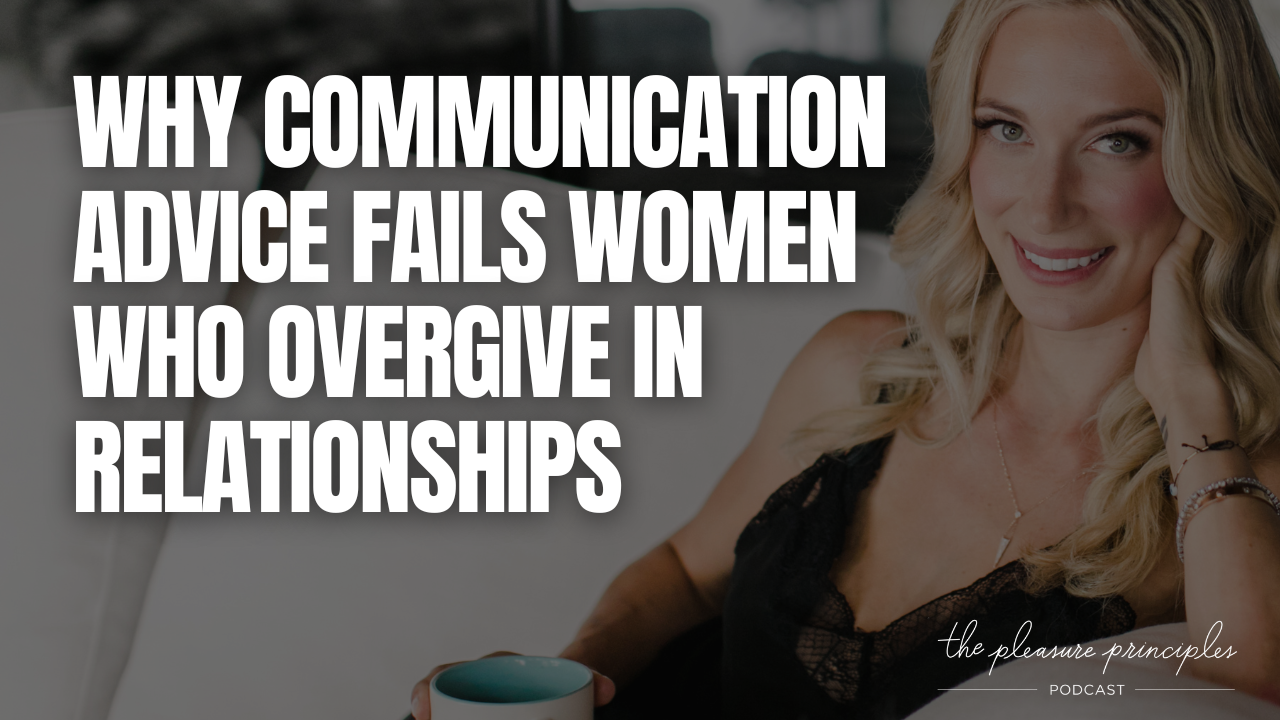
#210 Why Communication Advice Fails Women Who Overgive in Relationships
Most relationship advice says relationships are healthy when you communicate. Be open. Share your feelings. Explain your needs. Take responsibility for your emotions. This advice is everywhere, and on the surface, it sounds right. But for women with Super Traits, this framework often makes things worse, not better.
The problem is not that women with Super Traits are bad communicators. It is that they are exceptionally good communicators. They communicate clearly, thoughtfully, and with a high level of emotional awareness. They know how to reflect, repair, and take ownership. What no one talks about is that they do all of this at the cost of themselves.
LISTEN ON APPLE | LISTEN ON SPOTIFY | LISTEN ON AMAZON MUSIC
Take the FREE SUPER TRAITS QUIZ HERE
Women with Super Traits communicate at their own cost
Women with Super Traits communicate at the expense of their self-trust, clarity, desire, turn-on, and self-respect. They soften their language. They explain their needs carefully. They try again in different ways. They adjust their timing, their tone, and their expectations. Over time, they start lying to themselves, telling themselves that if they just communicate better or more gently, the relationship will eventually feel safe, connected, and reciprocal.
This is where intimacy begins to erode. No woman stays sexually open or emotionally alive when she has to gentle-parent her partner. Desire does not survive in relationships where one person is doing the emotional labor for both.
Why does communicating more create confusion instead of connection
Women with Super Traits believe in connection, repair, and hard work. These are the qualities that make them capable, reliable, and successful in every other area of life. So when something feels off in a relationship, they do what they know how to do: they communicate more.
They clarify how something made them feel. They explain their intention. They ask thoughtful questions. They watch their tone. They try to be fair and balanced. Instead of being met with curiosity or accountability, they are often met with minimization, defensiveness, denial, or the conversation being flipped back onto them. What started as a need for connection turns into reassurance, self-defense, and emotional cleanup.
Women leave these conversations feeling less certain than when they entered them. They feel scrambled, hollow, and confused, even though they communicated “correctly.”
How this pattern gets reinforced in therapy and relationships
When this keeps happening, women with Super Traits assume the problem is them. They assume they need to communicate better, more clearly, or more compassionately. Many spend years in therapy being encouraged to take even more responsibility because they are more emotionally aware, more tolerant, and more empathetic.
The burden of repair consistently lands on the woman with Super Traits. She is asked to understand more, wait longer, adjust her needs, minimize her desire, and make herself easier to be with. Accountability rarely lands on the other side. This pattern shows up not only in romantic relationships, but also in friendships, families, and professional environments, including workplaces run by high-achieving women.
Why the first step is actually communicating less
For women with Super Traits, the first step in healing is not learning how to communicate better. It is learning how to communicate less. This is not withdrawal, punishment, or emotional immaturity. It is discernment.
Women with Super Traits begin communicating less because their words are being used against them. Their vulnerability is reframed. Their clarity creates more confusion instead of resolution. They feel worse after trying to connect than they did before. Communicating less interrupts the cycle of over-functioning and emotional over-responsibility.
What changes when women stop over-functioning
Communicating less does not mean shutting down. It means stopping the habit of over-explaining in order to earn connection. A receiving woman lets behavior speak. She observes actions instead of negotiating words. She stops managing intimacy and carrying the emotional weight of the relationship.
When women with Super Traits stop over-functioning, clarity returns. Desire returns. Turn-on returns. Trust in self returns. No woman feels alive, creative, or connected when she is emotionally responsible for everyone around her. That is not emotional intelligence. It is emotional over-responsibility that quietly destroys relationships over time.
If communicating openly has left you feeling more responsible, more confused, and more alone, the problem is not you. The framework was never built for someone with Super Traits.
What to do next
If this resonates, the first step is understanding your Super Traits and how they are shaping your relationships, your body, and your nervous system. Most women know they are over-giving, but they do not understand why their body keeps choosing effort over receiving.
The Super Trait Quiz takes 3 minutes and identifies the exact traits driving your communication, intimacy, and connection patterns.
If you already understand the theory, have done therapy, and still feel like your relationships and life have not caught up, The Super Trait Society is the next step. This work is not about gaining more insight. It is about deconditioning survival patterns and retraining the body to receive without self-abandonment.
Decode the emotional and erotic patterns keeping you in over-functioning, shutdown, and inconsistent connection. The Super Trait Audit™ CLICK HERE
If you do not know your Super Traits, take the free Super Trait Quiz HERE.
If you want your world and relationships to respond to the woman you have already become, apply for The Super Trait Society HERE.
Connect with Dr. Jordin on INSTAGRAM HERE @drjordinwiggins

Hi! I'm Jordin, owner and creator of The Pleasure Collective
I believe that high-achieving women deserve deep intimacy, fulfilling relationships, and pleasure in every area of their lives—without sacrificing their success. My work helps women experience more energy, more connection, and feel fully seen, supported, and loved. I’m here to guide you in breaking free from burnout, prioritizing pleasure, and creating lasting fulfillment—emotionally, physically, and relationally.
